

nudity
* for the Buddhist terms used in this episode, there is a small glossary at the end

I ran after the rays of the setting sun, that warmed and blinded me.
At my ex-uncle Armand suggestion, I had changed into warmer clothes, picking a sexy Moncler long sleeved, second skin shirt that I had initially reserved for my return to civilization, for my nights out in Stockholm, since it delineated my muscles in a very generous way. But now I wanted to look good for Armand, more than to any anonymous Swedish guy I'd meet later.
Instead of waiting outside my hut, he had walked on his own towards the rocky point where we would watch the sun set. I had seen him start on the path of the setting sun on a deliberately slow walk, probably doing walking meditation.
As much as he wanted to give me time on my own, he probably needed it, too. But while changing -- into pants that did not leave any doubts that I had powerful thighs --, I could only feel the escalating excitement of being the lost heir of a Russian dynasty, that hadn't ended with Prince Aleksander Rostoff after all. Later I'd think more about that, probably try to get a signal for my mobile and call Catherine in ST. Petersburg at once -- and somehow celebrate.
I was aware Armand did not have much to celebrate, though. Except, perhaps, having survived my father and mother's betrayal, and his father and Celeste Mortinné's campaign against him. Armand had been too kind as to share all the ghosts in his life to simply justify why he was not my uncle.

I observed Armand's beautiful posture, as I approached him on the shore. He stood very straight without looking rigid, as if an invisible string was pulling the top of his head and sustaining him in the sky. He wasn't a tall or strong man -- and for a moment, I was ashamed to think how perfectly he would fit into my father's arms, or mine --, but he seemed to tower above all things. Slim as he was, he looked powerful. He was presence and center, and somehow all the beauty of sky and sea all around us seemed to emanate from him.
"So, what is it that you wanted to ask me, Laurent?" He asked softly.
I had expected we would watch the sun set in silence, as some sort of meditative exercise, like he had often done with my father on the Île du Blanchomme. But probably I was all on my own on the imaginary Île of their past, while Armand dwelled in the present.

"I'd love to hear about your experience as a monk." I said. I wanted badly to inquire about the Rostoff family -- that was now my own -- and about the dossier itself. And about Monsieur de Montbelle, guessing it might have been the last time Armand must have seen his father alive. Instead, I decided to spare my ex-uncle the prolonged torture, giving him the chance to share about a time that he reputed as one of the best in his life (I had read it in one of his rare interviews that versed on personal matters too).
"Really?" He gasped. Though Armand de Montbelle -- having won the Pritzker Prize like he had, the most important and prestigious any architect could wish for -- was not an insecure man, he seemed to doubt anyone could be interested in his personal life and not just his work and career, that had shaped and changed the world for better. "Why?" He asked, genuinely curious.

"I have thought of becoming a monk myself." I said. It was almost true. Having in my childhood learned meditation from my father -- who had learned it from Armand, I loved to recall that detail --, at least the basics, I had picked it again after Angelo dumped me. Having then spent some nurturing weeks in a Zen Buddhist monastery in France, I had almost considered becoming a monk -- almost. And now again, after my disastrous, frustrating conversation with Fabrizio, I had resumed meditating. So it was almost true.
"Really?" As Armand eyed me from head to feet, I had to wonder what he was seeing. Did he recognize my father -- once his sweetheart -- in me, putting his image upon mine every time he looked at me, I wondered. Though appreciative, his kind half smile did not reveal what he thought about me. Maybe, with my muscles and good looks, my physique du rôle was more adequate for a porn movie monk than a real life one?
*****

Having been with the forest monks in Thailand a little over a year before his return to become a monk himself, Armand was surprised to find they had been recently displaced, once more. The forest where he first met them had been cut down, the noble wood sold for furniture companies in Europe. Lifeless, ordained rows of eucalyptus grew instead in the grove where they had once practiced.
Happy to see a foreigner wishing to take the path of the Buddha, villagers indicated and even led the way to the monk's new dwelling. Armand followed uphill, until the source of a stream of limpid water -- that had already weakened but not yet totally dried --, to find the bikkhus had taken higher ground, in a forest that was less lush and shaded than that they were used to having for a canopy to embrace their practice. But they were not complaining. They would never protest, and instead see the teachings in each misfortune, that they did not even judged to be harmful or unwelcome.
With their own meager means and high skills, as an offer and honor, the villagers were still building huts to shelter the monastic community in the new location. Since not even the monks were quite settled in yet, Armand realized he would have to look for temporary accommodations until he could properly join them -- probably for the Rains Season, when more monks would come, and several laymen temporarily ordained.

Armand knew just the place.
A local entrepreneur had the lovely idea to build a restaurant as a floating house over a lake. After erecting the whole structure in wood, he realized to have no idea on how to bring electricity to the building. Back in the 1970s, electricity was reputed as a great attraction, since some villages around still did not have it, and especially for foreigners -- who had then just started exploring that part of the country --, used to those comforts back home. Armand was among the first foreigners in the region, then, on his first visit to the forest monks, and had been invited to help the amateur builder in finding a solution.
More than difficulties with idiom, they diverged in opinions and aims until Armand realized what his true -- and very humble, very limited -- role was. The architect in him wanted to consider security as a priority, without overlooking aesthetics, while his improbable, improvised and very practical client thought only of the costs. But even before they implemented a compromising solution, the man's 3 years old boy fell into the lake, while his father worked, and drowned.
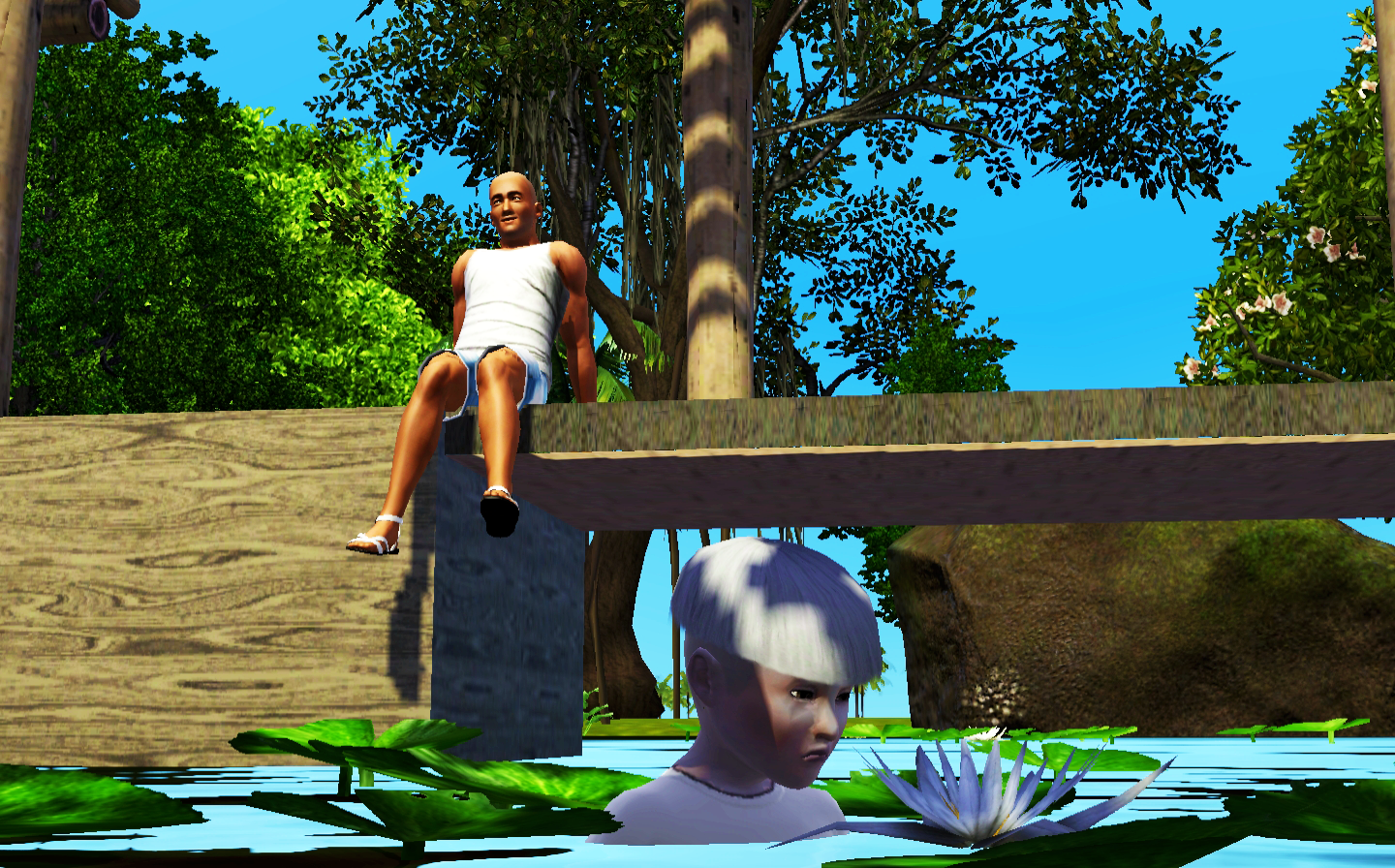
The restaurant was abandoned forever.
Or at least until Armand proposed to rent it for the entire dry season of 1975, by the end of which, with the arrival of continued rains, he expected to be a proper novice living with his monastic brothers in the forest.
Like on the Île du Blanchomme before, he had unexpected trouble finding workers who would help him with the property -- despite it being a valley of poor people, with few working alternatives but agriculture. Everyday, families would say goodbye to their youngsters, who left for the metropolitan centers in search of jobs and education. Despite his generous money offer, and being genuinely happy that Armand wanted to become a monastic -- a few even offered him shelter in their own homes --, they would not work for him in the abandoned restaurant. Like the Île, it was believed to be haunted, or at least a place of bad omens.
But he did not need many men, nor for long, since his project to make the restaurant livable was simple and did not include electricity nor running water -- and in a couple of weeks, after three different teams of scared workers had abandoned the site even if he paid overly well, the place was made adequate for his bare needs.
Leaving the room he had rented, Armand happily moved into the floating restaurant.

Instead of having built the missing walls, he placed light canvases on all side of the building. In less than 24 hours, he discovered none of them had been properly fixed to the wooden columns, all flapping to the wind like curtains. Though the noise was a bit annoying, when he looked around from the center of the big wooden square platform placed in the middle of the lake, he realized the privilege of having the neighboring groves only as walls, and no roof but the beams over his head. His sight wandered over the gleaming water -- so crystalline he could spot the fishes swimming in the lake -- without meeting any fixed limits at the margins, since bushes and trees swayed in the constant breeze, making inconstant walls. Everyday, new flowers blooming on the trees and bushes attracted his eyes with their bright reds and yellows and oranges, vivid like the perfume they emitted to attract the insects, making his nostrils tremble in the same process. Sometimes, he thought he could even perceive the growth of the plants around, and almost hear the sap running in them. Daily above him it were vast blue skies, crowded with stars in the evenings. The sensation of freedom he had once experienced on the Île du Blanchomme again returned to nurture him.
Yet, privacy was melancholically guaranteed by the wandering soul of the poor drowned boy. In the days to come, Armand would find a small altar with food, water and other offerings placed on the most remote corner of the lake -- that was as far as the villagers would approach the haunted property.

He started thinking of the refurbished, floating restaurant as his private, wall-less monastery where, except for the insistent mosquitoes tormenting trying to feast on him, he greatly enjoyed living in solitude and the gentle, wide embrace of the natural elements.
*****

One particularly warm and humid night, Armand woke up to an explosion of light. He had been dreaming of shooting stars, and for a moment, thought one had touched his heart. Instead, yet not less poetic, what had startled him was a firefly, landed inches away from his face, where it stood shining its emerald green light. On and off, on and off, to the beating of Armand's heart.
His watch indicated a quarter before 4 AM.

Determined to join the Sangha in the forest at once, he walked for some 40 minutes until spotting the warm, flickering light of a fire that led him to the group of monastics, quietly sitting in the coolest corner of the forested hill. It was about 4:30 in the morning, but the monks seemed immersed in deep meditation already. Armand, realizing to be late on his first day, approached carefully.
Doubting he might have recognized some of the faces in the semi darkness -- heads and eyebrows shaved, eyes closed, their faces displaying various shades of concentration and contentment, but floating equally neutral above the brown robes --, he did notice the former master to be gone, either dead or designated to a new monastery. The new teacher sitting at his place was much younger -- and that might explain why the Sangha was considerably smaller than previously, its members much younger, too.

Armand took seat in the periphery of the monastic group, a great distance separating him from the new master, who sat on a stone embraced by the thick aerial roots of a pair of giant banyan trees that leaned against one another. Armand had chosen a gentle slope where he wouldn't go unnoticed by the bikkhus -- not in his brand new, clean and shiny white vests of aspirant. At first he chose an open spot to be enveloped by the gentle, redeeming breeze, for he had already begun to sweat and smell, but soon felt concerned to have chosen ground higher than that were the master sat, which was considered an unforgivable offense. He thus moved to the bottom of the slope, where it seemed impossibly humid but adequate for a beginner like him -- a rather tactful move, for he was to find the younger teacher to be a whole more traditional, and very reluctant to accept a foreigner in the group.

Once he established his attention and then concentrated on the rise and fall of his abdomen, following the air in and out of his nostrils, Armand knew he could go on in the sitting position for hours, undisturbed -- proudly determined as he was to show them his commitment to the practice.
More than the heat and humidity, it was the night noises that annoyed him at first. Mysterious shrieks in the form of urgent calls echoed in the dark, and he could not guess if they came from birds in their nests or whatever sort of animals occupying the nearby caves. He could hear movement on the branches above him, near and far, and steps on the rug of fallen leaves all around him. Night birds flew about, some of them dangerously close to his head. He realized they were bats. He worried of smelling differently from the other monks, and to shine more than any other in his white robe -- and therefore attract animals that were otherwise accustomed to the group. Aware monkeys could be quite nasty and even aggressive sometimes, it was not of giant snakes and felines he was afraid of, but the hairy spiders, and treacherous scorpions. Even so, without ever opening his eyes to try to identify the source of the noises, he observed his fears rise and fall like his own belly with the breath, without judging them silly, disproportionate or even real. And as his concentration grew, he saw them dissipate and gradually disappear, grown weaker each time they tried to assault him.

Armand did not open his eyes nor move when the bell rang short after the sunrise, signaling the sitting was over. Hoping the monks, who slowly and almost inaudibly rose to their feet, would see it, he shone a smile on his face to indicate he was not asleep, but rather awake. He knew they were about to go on pindabat -- the alms round -- but wasn't sure he would be allowed to go with them, not under this new master. Being quite full from several days of cooking his own healthy food, he decided to skip all morning activities and instead endure the sitting position, until the monks would return for a second session.
Maybe later that same week he could help with building the huts -- he heard noises of construction all through the morning --, but firstly he wanted to establish and demonstrate the quality of his sitting.
And that's what he did, for days. He just sat and sat, each time trying to find a spot closer to the monastic group, which he did not try to contact. Nor did they ever try to contact him. In silence, he demonstrated his respect to the practice, the honesty of his intentions. And he thought they seemed to accept it -- he hoped.

For there was the barrier of language. Apart from daily greeting a few familiar villagers on his way to the meditation grove, openly smiling and being shyly smiled at in return, Armand spent his days in complete silence. He eagerly joined the monastic community in the chanting and other recitations, for he knew many verses by heart -- though not necessarily their meaning. He could even recognize a few terms from the suttas, but when it came to the teachings, given in Thai, it couldn't have been more frustrating. Apart from a few words in Pali, the simplest, he understood absolutely nothing. During the sermons, he could feel the master's reluctance growing almost solidly into despise -- or was it Armand's own reluctance growing into despair?
Armand had heard from a monk that the Dhamma -- the teachings of the Buddha -- was like rain. One would profit from it even when one did not quite understand it. The rain was not just for washing the leaves, or moistening and softening the superficial grounds. The teachings, like the rain, would naturally sink into the soil of his mind, reaching the deepest roots and seeds in his consciousness, without him doing nothing but willingly accepting and allowing it to happen. Still, it was too frustrating to just sit there, like an empty vessel, listening to word after word without them meaning anything to him.
He fell asleep during one of those sermons.

The previous night had been particularly tormented. After a period of relative peace with himself and the world, busying himself with remodeling the restaurant, lately he had started recalling Carlo. And Catherine. During the meditation session he did on his own, just before going to bed at home, they had sprung into his mind -- not as individuals, but more painfully, as a couple. He tried to get rid of his recollections of them -- but the more he fought his memories, and the sufferings past, the more they gave way to fantasies of the present. He saw them together, in each other's arms, and though he did not wish them any harm -- on the contrary, tried to wish them all the best --, their happiness harmed him, excluding his own.

That evening, he gave up the meditative battle against the lovers, and leaving his position on the cushion placed before the small altar, around which all other pieces of furniture seemed unimportant, he tried to slip into the oblivion of sleep instead. But on the bed it seemed even worse than the meditation cushion -- for it was the lover's place par excellence. Not until he moved on to the hammock, that was less comfortable and probably much warmer, but that he found empty of ghosts, did he meet some and little sleep.

Armand was ashamed to startle to his own snore, and regain conscience that the teacher was still giving the sermon. Shame was good, though, as he again felt alert -- but not for long, and he dozed back into sleep to be woken later by the bell, when all the other monks but him rose to their feet and bowed before the teachers -- the present master, and the Buddha, and the string of teachers connecting past and present -- to thank for the precious teachings that remained mysterious to him.
Feeling defeated, Armand gave it up for the rest of the day, and made his way home, very slowly, feeling Carlo and Catherine's ghosts would be there to greet him. Instead of shooing them, his only chance lied in making peace with them, letting them be, and making peace with his own suffering. That he knew. For, unlike the drowned, local boy who was believed to haunt the lake, Armand was aware to have imported his own ghosts. They walked with him; they lived in him.
*****

Some days, when the monks left the grove to go on their alms round, Armand -- no longer feeling the need to prove how long he could sit --, simply returned to his floating house to eat and rest, study and meditate.
At the bottom of one of his backpacks, he found the camera he had bought in Paris on an impulse, and since then, forgotten about it. He had heard of a Tibetan master living in the US who was encouraging his students to take on all tasks mindfully -- arts among them. And why not meditative photography? Armand decided to try it in a nearby grove. Not only had it survived deforestation so far, but it had remained virtually untouched by the villagers, who considered it haunted.
As he went from one flower to the other, and his eye followed the flights of insects and birds, he observed not just his awareness increase, but also his joy. And pleasure. For the first time he felt to be in Thailand enjoying himself, rather than punishing himself. More and more, he desired to stay on his own, feeling his practice was not being embraced by the bikkhus.
But that was about to change.

One afternoon, knowing no one would actually care, he arrived late for the second sitting of the day. At once, he spotted him, in a dark orange robe that indicate he belonged to another Sangha, where he must have been a novice -- another foreign monk. The young man was two heads taller than all the other Asian monks, even seated. And stronger, with broad shoulders stretching his outfit, and a tanned skin that fitted better on a surfer, or a swimmer.

Strategically taking his place again at the back of the group, from where he could see them all, Armand tried to focus on his breath ten thousand times, losing his concentration ten thousand and one times. Everything distracted him, from the poignant fragrance of the flowers blooming on the trees above him, to the erratic flight of bright butterflies, that mirrored his own mind state. The fast beating of the birds' wings, and their nervous shrill, was enough to accelerate his already jumping heart. He could hardly keep his eyes shut, fearing the surfer monk would evaporate, proving to be no more than a beautiful mirage created by his loneliness and desire. And Armand was genuinely relieved when, after the worst meditation session ever since he had arrived in Thailand, to the sound of the bell that ended the sitting, the young man did not disappear before his eyes.

For the first time, Armand joined the monks in their walking meditation. Placing himself right behind the foreign monk, to be the last in line according to his rank, he walked in rapture, without feeling the ground beneath his feet, knowing only that he was stepping where the other guy had stepped a moment before.

He tried to read the young man's nationality in his powerful neck, and guess his language from the light blond hair on his strong forearms. He calculated the newly arrived must be in his early twenties, despite some early wrinkles on the corners of his eyes that, together with calluses on his big hands, spoke of labors under the sun, or the disciplined practice of professional sport. A farmer, a basketball player?

Burning with curiosity, Armand jumped at the foreigner when the Sangha disbanded, at the end of the walking meditation, close to where the stream met a group of rocks and made an u-turn, starting to slowly make its descend towards the deforested plain below.
"Bienvenue, frére!" He said tentatively, joining the palms of his hands and bowing low to demonstrate his respect to a monk his superior -- though the guy was so tall, enough to be a basketball player, that anyone would always bow low to him.

"Je suis désolé." The man answered formally, in a voice that was grave and soft. Joining his palms and bowing to Armand, he did not stop walking as he said, "Je ne parle pas Français."
His accent did not leave any doubts about where he came from, Armand thought. Nor his typical All-American boy good looks.
"Welcome then, brother." Aware of the excitement in his own voice, Armand stepped into the other monk's orbit as if approaching a waterfall, like one does after weeks lost in the desert, unsure whether to start by sipping the water and plunging into the pool -- but certain of drowning anyhow. "My name is Armand. I'm very happy to have you here."
Filled with joy, Armand was smiling like he hadn't for months. But lost in the boy's blue eyes, bluer than the tropical skies above their heads, Armand overheard the young monk's Pali name and title when he introduced himself.

"I'm happy that you are happy." The monk added immediately, not giving Armand the chance to ask his name again. Even taken by ravishment, Armand could sense how the foreigner had tensed up to his proximity. On the guy's neck, strong like a bull's, and on his forehead, peeling from a recent sunburn, Armand could see veins swell and throb, tensely. "Now, if you will excuse me..." The handsome man added, while hastily walking away from Armand's presence, without ever reciprocating the smile. Despite his bulk, the young man's retreating steps made no whatsoever sound on the carpet of fallen leaves and flowers. A gymnast, a ballet dancer? And Armand was left behind hating the beautiful giant ferns around him for smelling so sensually of mating.
*****

For days, Armand followed the surfer monk -- in lack of a proper name, that's how he referred to him in his thoughts -- with his eyes only. The young man kept clearly demonstrating his intention to keep his privacy and distance, leaving no chance for Armand to approach him.
Armand could empathize with him, though. He had always himself enjoyed being the only foreigner in places. Countless times during his first trip to Asia he had felt frustrated upon meeting another gringo in the most remote villages, only to move further and farther.
And it was not only about the feeling of being unique.
Another foreigner brought back so many things he was trying to leave behind -- the possibility of conversations he would not like to have, on topics he'd rather forget, of impressions he would not like to share. Foreign languages stirred less emotions, he thought -- if any. Armand was aware of being a runaway, one running only after forgetfulness -- and he could understand when other foreigners behaved just like him, keeping the distance from one another.

So he was quite surprised -- to the point of almost dropping his cup of oolong tea, to then immediately depose it and run across the entrance bridge -- when, one afternoon, upon hearing clapping coming from the margins of the lake, his name was called.
"Brother Armand?"
He wouldn't have recognized his own name if he weren't living quite isolated there, hearing day after day the cries of parrots only. Armein. The accent making it sound so funny was unmistakable, the voice as powerful as the ample chest from which it originated.
"Are you there?"
*****

"Laurent, look!"
Armand had slowly turned his back to the setting sun, when it disappeared behind the horizon, and was pointing to the opposite shore of the island, where the full moon was rising.

Tears welled up in my eyes, as I immediately recalled one of many nights decades ago, when Armand and my father had watched the sun set and the moon rise, on the Île du Blanchomme. I wondered whether Armand recalled that too, and how they had called it "going to the movies" or something like it, in reference to one of their best loved dates in Paris, which was going to the Cinematéque Française. But those memories were fresher to me than to him, having just heard them from my father a couple of years ago. And it was very probable that, instead of touching Armand like did to me, they must have hurt.
bhikkhu: A Buddhist monk
Dhamma: The qualities of mind one should develop so as to realize the inherent quality of the mind in and of itself as taught by the Buddha.
Pāḷi: The canon of texts preserved by the Theravāda school of Buddhism and, by extension, the language in which those texts are composed.
Pāḷi: The canon of texts preserved by the Theravāda school of Buddhism and, by extension, the language in which those texts are composed.
Saṅgha: On the conventional level, this term denotes the communities of Buddhist monks and nuns; on the ideal level, it denotes those followers of the Buddha, lay or ordained.
sutta: Literally, "thread"; a discourse or sermon by the Buddha or his contemporary disciples. After the Buddha's death the suttas were passed down in the Pali language according to a well-established oral tradition, and were finally committed to written form in Sri Lanka around 100 BCE.


