
"Carlo..." I murmured, and I almost called my father 'mon cher Carlo'. "Can I ask you when did you travel to the Île du Blanchomme?" The truth is, I had not the faintest idea when my father had lived in Paris, nor any other date in his life, apart from the year of his birth. And that because, despite looking older, he was my mother's age. I waited and smiled, as I observed him frowning, concentrated in doing some mental calculations. Simple as they were, they might have been a challenge to him.

"It was the beginning of the 1970s... I graduated from the École in...1973, I'm almost sure about that. Or was it the end of 1972?" Like a little boy, he was counting his fingers. "Then I spent a year, or almost a year... but at least three seasons in that abandoned factory in Paris... Spring, Summer and Fall... So it must have been by the end of 1973 or the beginning of 1974, during the Winter, when I traveled to the Indian Ocean... Why, Laurent?"
"Nothing special." I lied. "I was just curious, trying to picture you, back then." Because I was doing my own calculations. I had been born in 1975 in Punaouilo, where Carlo had met Catherine, and now I was wondering when... and why... and how... he had crossed from the Indian Ocean to the Pacific Ocean, and what had happened to Armand, who hadn't gone with him. Or had he? Could Carlo have had both Armand and my mother as lovers, and at the same time? I started wondering how distant were Punaouilo and the Île du Blanchomme.
"Do you want me to continue with the story, son? Or are you bored?"
"Bored? Mon Dieu, no!" I was intrigued, or more than that, I was thrilled. And invested in what I sensed was my father's upcoming confession of a gay love affair in his youth. "Please, Carlo, please!"

"After having slept only a few hours, I still woke up much later than the other days. Armand was sound asleep, and I let him sleep." Carlo continued.
It had been a long night, full of acute revelations and intense emotions. A lot for both of us to take in, but for my friend, who had been living in a state of tension and expectation for so long, it must have been exhausting.

The sun was already high up, and it was too hot to sit to meditate under the shade of a palm tree.
Instead, I decided to go for a walking meditation around the island.
But I could not concentrate on my breath, nor my steps.
My mind was running wild, and for once I decided to let it run free, and follow its mad jumps and bumps, out through the malleability of time and into space immensity.
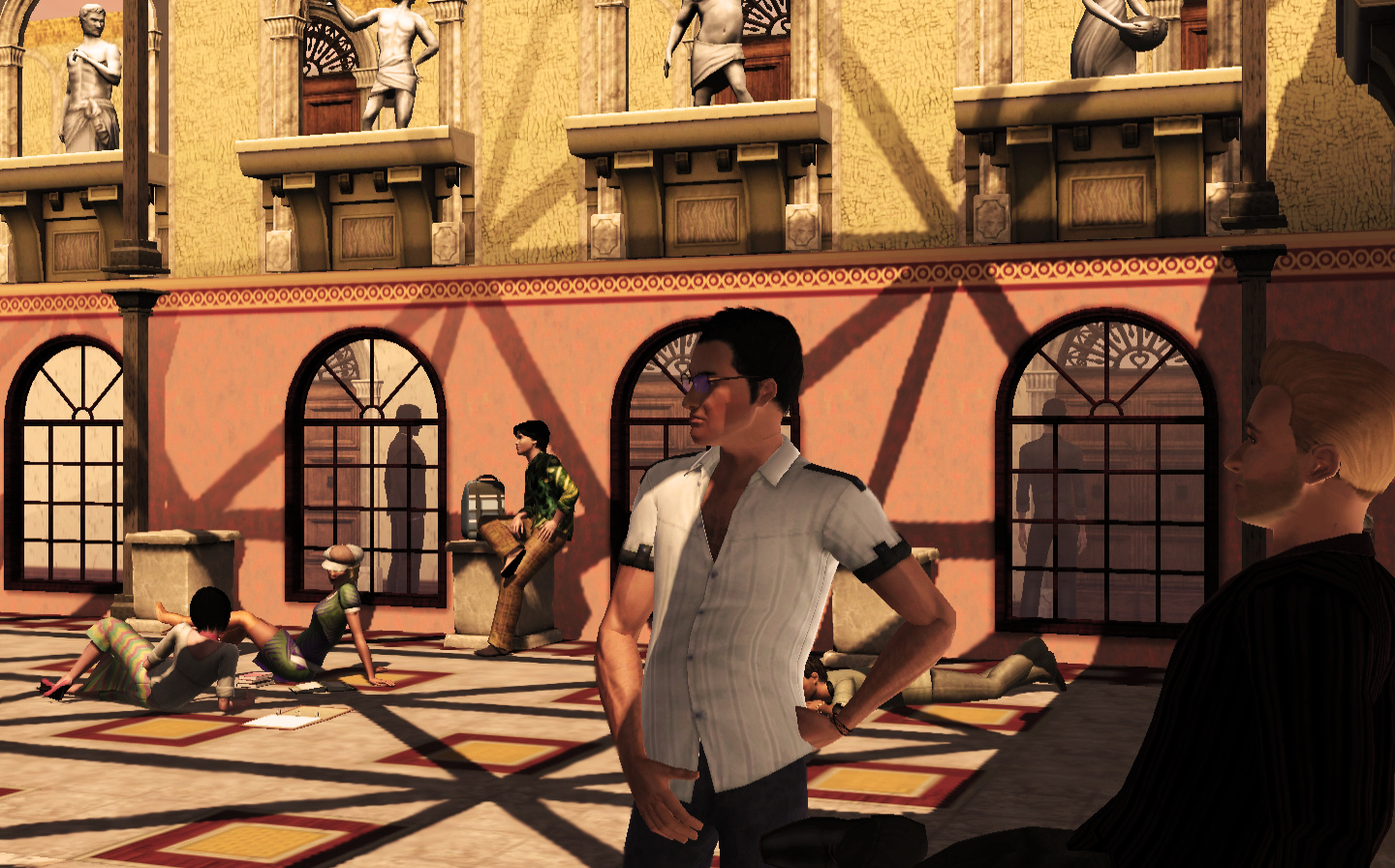
It came as an insight to me that Armand and I had never been too personal in our conversations. Maybe when we spoke about our respective families and childhoods, our upbringing, our share each of solitude as only children. But that was all, and it wasn't often. Hadn't the previous night, as we immersed ourselves in the stimulating smells and gentle sounds of a tropical, secluded island where we were the only human beings, been the perfect cradle of an unforgettable first time -- when we had really and deeply opened our hearts to one another?
We had been constantly together -- or seeking one another's company in Paris --, even if we studied different disciplines at the École des Beaux-Arts. Architecture for him, and Fine Arts for me. That had actually helped our friendship, since we had even more knowledge and fresh information to exchange. And all the time, we had talked to one another, a lot, interminably during the days and often late into the nights, until we'd fall asleep, exhausted and satisfied.

We arrived in Paris in 1969. That's an easy enough date to remember, because everybody kept saying we were one year late. I was constantly being informed that I had lost one of the grandest moments in the history of the city, that had affected the whole country, maybe the whole western world. Everything had changed, everything was new. But whatever the changes May 1968 had brought, I could not have guessed -- to me, a peasant coming from the isolated high mountains, it was all indeed new. Can you imagine the day I arrived in Paris, Laurent? When I stepped from the train onto the platform, it was as if my senses had blown up -- and for months I felt they were daily being heightened. Of course I had noticed how the scenery had changed, from the little village where I boarded the first local train with other peasants and chickens, to become increasingly more dense, and populated, villages turning into cities, and for the first time my eyes met the fascinating ugliness of the industries and the frightening clutch of the suburbs. But nothing had prepared me to Paris -- its noises, smells, the long avenues I had to walk all on my own looking for the Auberge de la Jeunesse, as the cars and scooters went by in an unbelievable speed, as I went by the array of shops and fancy dressed people in a mesmerizing, affluent stream of diversity. The other students could mock me, and say whatever they wanted -- everything was new to me, including the language, the food, the school, bearing my ways in the academic world and venturing into my own artistic path. I wasn't more overwhelmed because I was so humble and poor, and could not really mix with the Parisian crowds, that I watched from a prudent distance.
To Armand, a prince brought up not far from the City of Light, that he had been often visiting, nothing was really new in Paris. He had watched the news about the student's revolution on TV, at his home in the Chateâu de Montbelle, and after the initial shock and wave of fear, a certain natural and defiant or artificial, defensive blasé attitude he seemed to cultivate, had taken over. Contrary to me, he seemed to glide untouched and unaffected through the admirable new world people praised around us.
Or so I believed.
We arrived in Paris in 1969. That's an easy enough date to remember, because everybody kept saying we were one year late. I was constantly being informed that I had lost one of the grandest moments in the history of the city, that had affected the whole country, maybe the whole western world. Everything had changed, everything was new. But whatever the changes May 1968 had brought, I could not have guessed -- to me, a peasant coming from the isolated high mountains, it was all indeed new. Can you imagine the day I arrived in Paris, Laurent? When I stepped from the train onto the platform, it was as if my senses had blown up -- and for months I felt they were daily being heightened. Of course I had noticed how the scenery had changed, from the little village where I boarded the first local train with other peasants and chickens, to become increasingly more dense, and populated, villages turning into cities, and for the first time my eyes met the fascinating ugliness of the industries and the frightening clutch of the suburbs. But nothing had prepared me to Paris -- its noises, smells, the long avenues I had to walk all on my own looking for the Auberge de la Jeunesse, as the cars and scooters went by in an unbelievable speed, as I went by the array of shops and fancy dressed people in a mesmerizing, affluent stream of diversity. The other students could mock me, and say whatever they wanted -- everything was new to me, including the language, the food, the school, bearing my ways in the academic world and venturing into my own artistic path. I wasn't more overwhelmed because I was so humble and poor, and could not really mix with the Parisian crowds, that I watched from a prudent distance.
To Armand, a prince brought up not far from the City of Light, that he had been often visiting, nothing was really new in Paris. He had watched the news about the student's revolution on TV, at his home in the Chateâu de Montbelle, and after the initial shock and wave of fear, a certain natural and defiant or artificial, defensive blasé attitude he seemed to cultivate, had taken over. Contrary to me, he seemed to glide untouched and unaffected through the admirable new world people praised around us.
Or so I believed.

We first met in a museum, starting a conversation over two paintings in a corner. They showed the Russian writer Dmitriy Furmanov in an aristocratic pose, and on the other was an anonymous young man sketching -- we couldn't have been each better represented in those depictions. I was visiting the museum for the first time, while Armand was there again just for his best loved paintings. From that specific pair, he knew plenty of details and was eager to share them with me. From the start, he was my first master in Paris.

At some point during our conversation, I recall him mentioning he had already seen me at the École. Naively, unaware of the wealthy person I had before me, I asked him if he knew someone who wanted to share a room -- because I'd have to leave the Auberge de la Jeunesse soon --, implying that maybe he needed a room himself. And after a lovely day well spent together at the museum and the nearby park, having both realized how our presences harmonized and we easily congregated, having shared impressions and opinions in an unstoppable torrent that left us stimulated and pacified at the same time, came Armand's invitation to visit the apartment his father had rented for him, to see whether I would like to share it with him.

For me, his small apartment in the bustling 6e arrondessiment, that he had described as being quite modest -- since he held the Château de Montbelle as comparison -- was instead luxurious, even grand, if I were to have the Auberge and even our stone house in the Apennines in perspective. And for the next five years, realizing I was in Paris at my own expense, Armand did not allow me to pay more than the amount I had payed for a bed at the Auberge, since I had insisted in paying him something at least.
At the beginning of my stay in Paris, your great-grandfather Tarso was too disappointed and angry at me for having abandoned him in the Apennines, and would not send me any money. Not that I ever asked him for any aid, ever. I knew he would never agree with and approve of my decision to leave our ancestral lands to study and practice Painting in Paris. But later he repented, and did start sending me whatever little money he spared.
Though I had to work hard to make money in Paris, painting walls here and there, it was a derisive amount I handed Armand every month. But he always found a way of returning the money, buying art supplies, books or even clothes for me.

Armand and I came from completely different backgrounds. And instead of separating, those differences fascinated and reunited us. Armand thought it was magical and a very special form of wisdom that I could guess the weather from looking at the sky and the clouds, taking in consideration the sun and moon lights, as soon I started understanding what the climate in Paris was like. And point to him that a rose was not an azalea, or that strawberries and pumpkins did not grow on trees. He was astonished with all the information I poured on him as we walked around the Jardin des Tuileries, just across the Seine river from our school. I never judged him silly for mistaking a raspberry for a cherry, because that would have made me silly, myself.
And if I had never been to a museum nor a theater before I had joined the École, Armand had already visited them all in most European countries. Those previous visits with his parents, and an impressive quantity of books he had read, turned him into the most accomplished guide to the Parisian cultural life I could have wished for. And I never judged him arrogant, nor ever thought he was showing off his knowledge, since it felt like just another form of his generosity pouring over me.
And if I had never been to a museum nor a theater before I had joined the École, Armand had already visited them all in most European countries. Those previous visits with his parents, and an impressive quantity of books he had read, turned him into the most accomplished guide to the Parisian cultural life I could have wished for. And I never judged him arrogant, nor ever thought he was showing off his knowledge, since it felt like just another form of his generosity pouring over me.

To me, it was a budding period! Armand delighted in introducing me to so many wonderful places and things. We would stroll through the city for many hours, while he pointed all sites of interest, and told their history. From the alleys mentioned by Hugo in Les Miresables to all the sceneries from Balzac's novels, Armand made Paris an even more fascinating, lively city for me. Thanks to him, I could recognize the spots depicted in several paintings, too, and the Arts dominated my daily life in an interplay between past memories, or depictions, and present impressions.
Whenever he had two tickets or the entrance was free, we would go to museums, theaters and the movies together, preferably at the Cinémathèque Française. Chabrol and Costa-Gravas, Louis Malle and François Truffaut, Godard and Resnais, but also Visconti and Bergman and Tarkovsky -- I discovered them all under Armand's enthusiastic guidance. And from his frequent dates with the well-off girls, he would always bring me the exquisite booklets of the best operas and plays in town, that I could not go to myself. What else could a peasant like me have wished for? My life was already richer than I had ever pictured.
Whenever he had two tickets or the entrance was free, we would go to museums, theaters and the movies together, preferably at the Cinémathèque Française. Chabrol and Costa-Gravas, Louis Malle and François Truffaut, Godard and Resnais, but also Visconti and Bergman and Tarkovsky -- I discovered them all under Armand's enthusiastic guidance. And from his frequent dates with the well-off girls, he would always bring me the exquisite booklets of the best operas and plays in town, that I could not go to myself. What else could a peasant like me have wished for? My life was already richer than I had ever pictured.

For many days we would debate about a controversial play or movie we had watched. Since my French was just rudimentary in the beginning, Armand also shared his books with me, and was very patient and dedicated in teaching me his language. I had never read French poetry before he gave me Baudelaire's 'Les Fleurs du Mal', followed by Rimbaud's 'Le Bateau ivre'. I flipped, as with my friend's aid I made my way through French Literature. In the five years we were roommates, he erected a wonderful library in our apartment, that I profited so much from. We used to call it 'The Church', our church. "Let's go to church?", "Let's meet at the church after class?" It sounded completely démodé, and listening to that our colleagues from the École regarded us as two antiquated religious fanatics, while we rejoiced with our private joke.

It's funny to recall how much time we spent just talking, debating, discussing. Many times we would miss a meal or even class because we engaged in a conversation and forgot about everything -- and everyone -- else.
We rarely discussed politics. The Cold War and the Vietnam War were going on, but we lived in a private, rather harmonious world we had built at our apartment, and that we took with us everywhere that we would go, in our conversations and the immense pleasure we had in each other's company.
But religion was an almost daily topic. Actually, it was more on spirituality, since none of us was religious, despite our anecdote about 'The Church'. We both agreed that religion actually parted us from experiencing the sacredness of all things. We debated about God -- the concept, the idea, its existence or non existence -- and on faith. It strengthened our bonds, since not many students our age had interest on those topics in those days.
But religion was an almost daily topic. Actually, it was more on spirituality, since none of us was religious, despite our anecdote about 'The Church'. We both agreed that religion actually parted us from experiencing the sacredness of all things. We debated about God -- the concept, the idea, its existence or non existence -- and on faith. It strengthened our bonds, since not many students our age had interest on those topics in those days.
The meaning of life? Were we born with a mission or a purpose in life? Or was the purpose of life simply giving life a purpose?
Armand was highly cultivated and would bring quotes from Plato, Kierkegaard, Teilhard de Chardin, and other names I'd hear for the first time in our conversations. I'd talk about the crops and the seasons, about magnificent lightning storms and the fierce winds in the mountains, about observing a baby deer daily evolving, and all the corresponding insights I had gained through those experiences.

Though many times we agreed on books and movies, more than not, to me it actually didn't matter whether we concurred on a subject or not. I didn't have to like Heidegger nor the Bauhaus school; to me it was important how these fresh things Armand kept bringing up would help me to avert my peasant past and build a brand new future. Like I had learned to comply and silence when he raised his hand to interrupt me, before I let out some foolishness, I easily gave in to his opinions, and let him conduct me in the world of high culture. Just like he would let me guide him through the gardens and along the alleys of the Parisian parks naming plants and animals for him, though often in Italian, directing his awareness towards the birds singing and the rustling of the leaves, the perfume of the flowers or the scent of rain coming with the wind. On the other hand, he introduced me to Kandinsky and Morandi, among other wonderful painters -- his advice and trained glance would influence my own painting --, while I made him notice the intricately beautiful patterns of moss and the variety of shapes in the clouds.
Armand too, with my company and rather erratic guidance, had started diverting from his past. Showing him how a simple pebble could be as unique and beautiful as the marble that adorned the palaces in Paris -- as well as his own Château de Montbelle --, was rather revolutionary in terms of his cultivated tastes and values. Having an eye to tell the difference between Carrara and Calacatta marbles, it was literally groundbreaking that I would point at the beauty ordinarily existing underneath his feet.

But who could have guessed the ashrams in faraway India were coming into his life? And that I was the one to be responsible for that addition, and the upcoming shift in Armand's perspectives? I am pretty sure I had never heard about any of those Indian philosophies before I stumbled upon Heinrich Zimmer's book, the one that had made a long, unauthorized journey from a Parisian café to rest in Herr Weismann's libray on the Île du Blanchomme.
next episode
But who could have guessed the ashrams in faraway India were coming into his life? And that I was the one to be responsible for that addition, and the upcoming shift in Armand's perspectives? I am pretty sure I had never heard about any of those Indian philosophies before I stumbled upon Heinrich Zimmer's book, the one that had made a long, unauthorized journey from a Parisian café to rest in Herr Weismann's libray on the Île du Blanchomme.
next episode


